
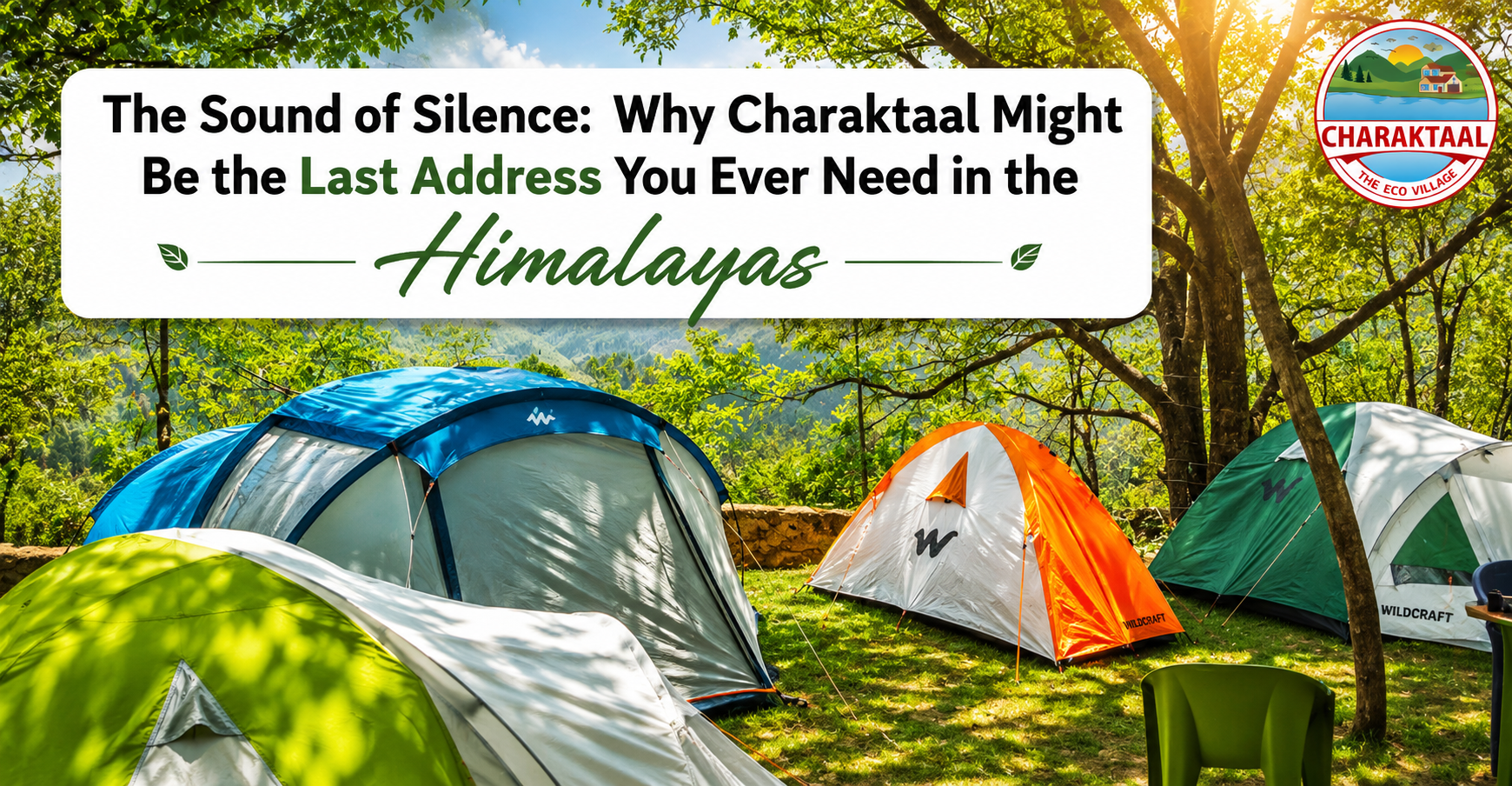
There is a particular kind of silence that exists only in the hills — not the absence of sound, but a fuller, older kind of quiet made up of wind moving through deodar branches, a distant temple bell, birdsong you can’t quite name, and the soft crunch of your own footsteps on a forest trail. City silence is something you fight for. Himalayan silence is something that simply arrives, unasked, and settles into your chest like a long-overdue exhale.
This is the silence that surrounds Charaktaal.
Tucked into the folded green hills near Lansdowne, Uttarakhand, Charaktaal Eco Village isn’t just another real estate project riding the “second home in the mountains” wave that has swept through India’s investor class over the last few years. It is something more deliberate — an attempt to build a community where sustainability isn’t a marketing checkbox but the actual architecture of daily life, and where the phrase “wellness real estate” gets to mean something more than a spa in the clubhouse.
Let’s walk through what makes Charaktaal worth paying attention to — not as a pitch, but as a genuine look at what’s being built in one of the most underrated corners of the Himalayan foothills.
Where, Exactly, Is Charaktaal?
Lansdowne has long been the quieter, more composed cousin of Nainital and Mussoorie — a cantonment town that never fully surrendered to mass tourism, still wrapped in oak and pine forest, still cool enough in May to need a light jacket in the evenings. Charaktaal sits close to this town, roughly 25 kilometers away, which means residents get the benefit of Lansdowne’s charm — its colonial-era churches, its regimental museums, its unhurried bazaar — without living inside the tourist traffic itself.
The broader connectivity map is generous for a project this secluded. Haridwar, the spiritual gateway to the Himalayas, is about 65 kilometers away. Dehradun’s airport is roughly 120 kilometers out, which puts Charaktaal within a comfortable half-day’s reach of Delhi-NCR for anyone driving up for a weekend, and within a short domestic flight plus a scenic drive for anyone coming from further afield. Kotdwar’s railway station and a network of motorable roads round out the access points, meaning the “middle of nowhere” feeling of Charaktaal is a feeling, not a logistical reality.
And the neighborhood, so to speak, is stacked with reasons to linger. The Durga Devi Temple and Sidhbali Dham offer spiritual detours. Tadkeshwar Mahadev and Kanvasharam carry their own layers of mythology and history. For anyone whose idea of a weekend includes wildlife rather than just wellness, Corbett National Park — India’s oldest national park and a genuine tiger reserve — is within reach, along with the Army War Museum and St. John’s Church for those who like their hill stations with a side of heritage architecture.
In short: Charaktaal isn’t isolated. It’s insulated. There’s a difference, and it’s the difference that matters most to anyone who has ever bought a “peaceful getaway” only to discover it’s an hour from the nearest working ATM.
The Philosophy Behind the Plots: Heal, Play, Live
Most residential projects lead with square footage. Charaktaal leads with a philosophy, organized around three words: Heal, Play, Live.
It’s easy to be skeptical of real estate developments that reach for wellness language — the industry has, admittedly, worn out phrases like “holistic living” and “mindful spaces” through overuse. But at Charaktaal, the framing seems to come from an actual design intent rather than a marketing afterthought.
Heal is built around the idea that abundant sunshine, clean water, and organic nutrition are not luxuries but the actual foundation of a functioning life — the elements most of us have quietly lost access to while living in polluted, artificially lit, processed-food cities. The project’s positioning as a “zero pollution zone” isn’t just an environmental flex; it’s central to what the developers are calling nature’s elixir — the basic inputs of health that urban life has slowly stripped away.
Play leans into something we tend to forget as adults: that a balanced mind and body crave exploration, not just rest. This isn’t a retirement community built around stillness. It’s designed for movement — for people of every age to rediscover the version of themselves that used to climb trees, walk without a destination, or simply sit outside without a screen in hand.
Live is the summary state — the promise that daily life at Charaktaal can be soulful without being austere, luxurious without being loud. A serene walk through the property, the developers suggest, is meant to nurture mind, body, and soul simultaneously, rather than treating those as three separate wellness verticals to be addressed in three separate rooms of a spa.
Interestingly, the project also draws on Reiki symbolism as part of its identity — the Choku Rei, associated with power and energy, and the Sei He Ki, associated with purification and protection, alongside the lotus flower as a symbol of renewal. Whether or not you personally practice energy healing, the symbolism signals something about intent: this is a project that wants residents to feel a sense of ritual and renewal in their surroundings, not just proximity to nature as a backdrop.
What You Can Actually Own
Philosophy aside, the practical question anyone asks about a project like this is simple: what am I buying, and what do I get?
Charaktaal’s master plan is organized around four categories of ownership:
- Plots — for those who want to design and build their own home from the ground up, on land that’s already zoned and infrastructure-ready.
- Studios — smaller, move-in-ready units suited to weekend getaways, rental income, or a lower-commitment entry point into the community.
- 2 BHK Luxe Villas — full family homes with the comforts of a permanent residence but the setting of a retreat.
- 3 BHK Sky Mansions — the project’s flagship offering, larger homes presumably positioned to take advantage of elevated views and more expansive layouts.
The site itself is planned with wide internal roads — 20, 25, and 30 feet — clearly demarcated zones for each category of home, dedicated green belts, and central gathering points with walking circuits threading through the property. This is a meaningful detail: a lot of hill developments treat “green space” as whatever land is left over after construction. Charaktaal’s stated commitment is that 65% of the property remains open green area, which — if it holds — puts the built environment firmly in the minority, with nature doing most of the talking.
The Infrastructure of a Quiet Life
It’s one thing to promise forest views and birdsong. It’s another to make sure residents don’t have to sacrifice modern comfort to get them. This is where Charaktaal’s amenity list becomes genuinely interesting, because it spans four very different categories of need.
On the Nature & Wellness side, there’s a yoga and meditation deck, organic gardens residents can presumably draw from, and forest bathing trails — a nod to the Japanese practice of shinrin-yoku, which has increasingly strong research behind its effects on stress reduction and mental clarity.
On the Community & Lifestyle side, there’s a clubhouse with a multipurpose hall, an open-air amphitheatre for gatherings and performances, and a dedicated children’s play area — a signal that this is meant to be a multi-generational community, not just a couples’ retreat or a solo investor’s asset.
The Modern Infrastructure category covers the unglamorous but essential stuff: 24×7 security and surveillance, underground cabling, adequate water storage, and solar-lit common areas — the kind of details that determine whether a hill property is livable year-round or just a pretty photo backdrop for three months a year.
And on Sustainability, the headline commitments are rainwater harvesting, solar-powered lighting across a significant share of the property, and gated, CCTV-monitored security paired with genuinely low-impact construction. The numbers being cited — 66% open green areas, 80% solar-powered lighting, 90% gated security coverage — suggest a project trying to hold itself to specific, checkable targets rather than vague sustainability language.
Why the Investment Case Is More Than Scenery
There’s a version of this article that stops at “the mountains are beautiful, buy land here.” But the more interesting question for anyone actually considering Charaktaal is: does this make sense as an investment, not just an escape?
A few structural factors work in Charaktaal’s favor. First, Uttarakhand’s hill destinations have seen a sustained rise in demand from Delhi-NCR buyers over the past several years, driven by remote work flexibility, a post-pandemic reassessment of what “home” should feel like, and a broader appetite for second homes that double as rental assets during peak tourist seasons. Second, Lansdowne specifically has managed to stay under-touristed relative to Nainital, Mussoorie, or Shimla, which — depending on how you read it — either signals lower current demand or genuine early-mover opportunity, since Lansdowne has begun appearing more frequently on “underrated hill station” lists precisely because it has resisted overdevelopment so far.
Third, the “zero pollution zone” positioning matters more than it might seem. As Indian cities continue to grapple with severe air quality crises — Delhi’s winter smog being the most visible example — demand for genuinely clean-air second homes within a reasonable driving distance is only going to intensify. A property that can credibly claim clean air, biodiversity, and low-density living isn’t selling a lifestyle preference anymore; it’s selling a health outcome.
That said, land investment near hill stations comes with its own due diligence checklist, and prospective buyers should approach any purchase — Charaktaal included — with the same rigor they’d apply anywhere: verifying land titles and zoning approvals, understanding the phased delivery timeline for infrastructure like roads and utilities, checking the developer’s track record on prior projects, and getting clarity on maintenance and community management structures once the village is occupied. Charaktaal Greens points to other developments — including Jusgar Resort and Eco Valley — as part of its portfolio, and any serious buyer would do well to look at how those projects have actually played out on the ground, not just on the brochure.
A Day That Doesn’t Feel Like an Escape From Anything
Perhaps the most compelling way to think about Charaktaal isn’t through square footage or amenity checklists, but through what an ordinary Tuesday might actually feel like there.
Morning starts not with an alarm competing against traffic noise, but with light filtering through pine cover and the sound of birds that don’t have names in your phone’s app yet. A walk through the forest bathing trail before breakfast, coffee made from water that hasn’t traveled through miles of aging municipal pipe, maybe twenty minutes on the yoga deck before the day gets any louder than it needs to be.
Work — because most people buying into a project like this aren’t retiring, they’re relocating a laptop — happens from a home that gets more daylight than any apartment in Delhi or Gurugram ever could. Lunch might include vegetables from the organic garden. In the afternoon, there’s an actual choice of what “outside” means: a walk to the amphitheatre for a community event, a drive to Lansdowne for the bazaar, a quiet hour at the Durga Devi Temple, or simply sitting somewhere green with no particular plan.
Evening brings the kind of dark sky that most of urban India has permanently lost — solar-lit pathways rather than the sodium-orange glow that blots out stars in every metro. And the night closes not with the low hum of traffic that most city-dwellers have stopped consciously hearing, but with actual silence — the good kind, the kind Charaktaal is, in its own way, built entirely around.
The Bigger Question Charaktaal Is Really Asking
Strip away the amenity lists and the master plan diagrams, and Charaktaal is ultimately asking its prospective residents a bigger question: what if where you live actually shaped how well you lived, rather than the two being entirely disconnected?
For decades, Indian real estate has largely optimized for proximity — proximity to offices, to schools, to malls, to metro stations. Charaktaal is a bet on a different optimization entirely: proximity to clean air, to silence, to forest, to a slower and more deliberate rhythm of days. It’s a bet that as remote work becomes normalized and as urban air quality continues to deteriorate, more people will start asking not “how close is this to my office” but “how close is this to actually feeling well.”
Whether Charaktaal fully delivers on that promise will depend on execution — on roads getting built as planned, on the green cover staying at 65% rather than eroding under construction pressure, on the community genuinely forming rather than remaining a collection of empty weekend homes. Those are fair questions for any buyer to ask, and worth asking directly during a site visit rather than taking entirely on faith from a website.
But the underlying premise is a good one, and increasingly a necessary one. In a country where “escape to the hills” has become a genuine wellness strategy rather than just a holiday cliché, Charaktaal is staking its claim on the idea that a home can be the elixir itself — not a place you retreat to when life gets overwhelming, but the actual, everyday antidote to it.
Sometimes the most valuable thing a piece of land can offer isn’t a view. It’s quiet. Charaktaal is betting that, for a growing number of people, quiet is exactly what they’ve been looking to buy.
Charaktaal Eco Village is located in Lansdowne, Uttarakhand. For site visits, master plan details, or booking inquiries, reach out through charaktal.com.