

There’s a reason you exhale a little deeper the moment you step under a canopy of deodar trees. It isn’t in your head—or rather, it is, but not only there. It’s in your bloodstream, your nervous system, your immune cells. For decades, this was just something people felt and never quite explained. Now there’s a name for it, a growing body of clinical research behind it, and—if you’re standing in the pine-scented hills of Lansdowne—quite possibly a home address for it.
The practice is called shinrin-yoku, or forest bathing. It originated in Japan in the 1980s as a public health response to a very modern problem: a population working itself into the ground with almost no exposure to the natural world. Nearly forty years later, it’s no longer a wellness trend confined to spa brochures. It’s a documented, measurable, repeatable physiological intervention—and understanding why it works changes the way you think about where you choose to live, not just where you choose to vacation.
At Charaktaal Eco Village, forest bathing trails aren’t a marketing flourish tucked into an amenities list. They’re the whole premise. But before we get to that, it’s worth understanding what’s actually happening inside your body when you walk into a forest—because the science is far more specific, and far more compelling, than “nature is relaxing.”
The 20-Minute Reset Your Nervous System Has Been Asking For
Here’s the part that surprises most people: you don’t need a weekend retreat or a two-week detox to get a measurable benefit. Researchers studying urban populations have found that meaningful, measurable drops in cortisol, blood pressure, heart rate, and sympathetic nervous system activity—the biological signature of stress—show up after roughly twenty minutes of exposure to a forest environment. Not twenty days. Twenty minutes.
A 2019 systematic review and meta-analysis published in the International Journal of Biometeorology pulled together data from studies across multiple countries and found a consistent pattern: people measured after time in a forest environment showed significantly lower cortisol levels than comparable groups in urban settings, both before and after the forest exposure took place. In plainer terms, the forest group’s stress hormones were lower even walking in, and lower still walking out.
More recent clinical work has pushed this further. A quasi-experimental study conducted in Brazil, published in Frontiers in Public Health, tracked participants through eight forest bathing sessions against a control group exposed to guided urban environments over the same period. The results weren’t subtle.
Systolic blood pressure dropped from an average of 119.5 to 108 mmHg, and salivary cortisol fell from 0.29 to 0.16 µg/dL among the forest-exposed group. The proportion of participants classified as experiencing low stress rose from 17.4% to 52.2%.
This isn’t a placebo dressed up in pine needles. A newer narrative review of the field found that forest exposure is associated with enhanced natural killer cell activity, changes in inflammatory markers, reduced cortisol, and a measurable shift toward parasympathetic dominance—the “rest and digest” branch of your nervous system that urban life rarely lets you access. Some researchers even point to airborne compounds released by trees, phytoncides, as a possible contributor to the immune effect—your body responding not just to the visual calm of a forest, but to what you’re literally breathing in.
None of this requires you to believe in anything. It’s blood pressure cuffs and saliva samples, not incense and affirmations.
Why the City Can’t Give You This, No Matter How Many Wellness Apps You Download
There’s an entire industry now built around simulating what forests give you for free: white noise apps that loop birdsong, weighted blankets marketed as “grounding,” ten-minute meditation videos filmed in front of a screensaver of a waterfall. None of it is wrong, exactly. It’s just a workaround—a way of approximating something that used to be available simply by walking outside.
The uncomfortable truth is that most Indian cities have engineered nature almost entirely out of daily life. Green cover in major metros has been shrinking for years under the pressure of construction and infrastructure demand, and the health consequence isn’t abstract—it shows up in exactly the biomarkers the forest-bathing research tracks: elevated resting cortisol, poor sleep architecture, and a nervous system that rarely gets the “stand down” signal it was designed to receive daily.
You can meditate in a flat that overlooks a flyover. You can do yoga on a rooftop that faces another rooftop. But there’s a difference between practicing calm and being handed it by your environment, and that difference is exactly what forest bathing research keeps measuring: the forest doesn’t ask your mind to work at staying calm. It simply removes the inputs that were keeping you activated in the first place.
This is the argument for where you live mattering as much as how you live. You can only meditate your way out of stress for so many minutes a day before you have to go back outside and re-enter the noise. What if the noise simply wasn’t there to re-enter?
Lansdowne: A Forest That Was Never Meant to Be a Weekend Trip
Lansdowne has spent the last decade as one of Uttarakhand’s best-kept secrets—a colonial-era cantonment town wrapped in Himalayan oak and deodar forest, deliberately kept low-key by its status as a military base, which has kept mass tourism and haphazard construction largely at bay. It’s the rare hill destination that hasn’t yet been flattened into a strip of hotels and honking traffic.
That’s precisely why it’s become the setting for a different kind of real estate conversation. Not “where can I build a getaway house,” but “where can I build a life that includes this kind of air, this kind of quiet, this kind of forest, as a daily condition rather than an annual indulgence.”
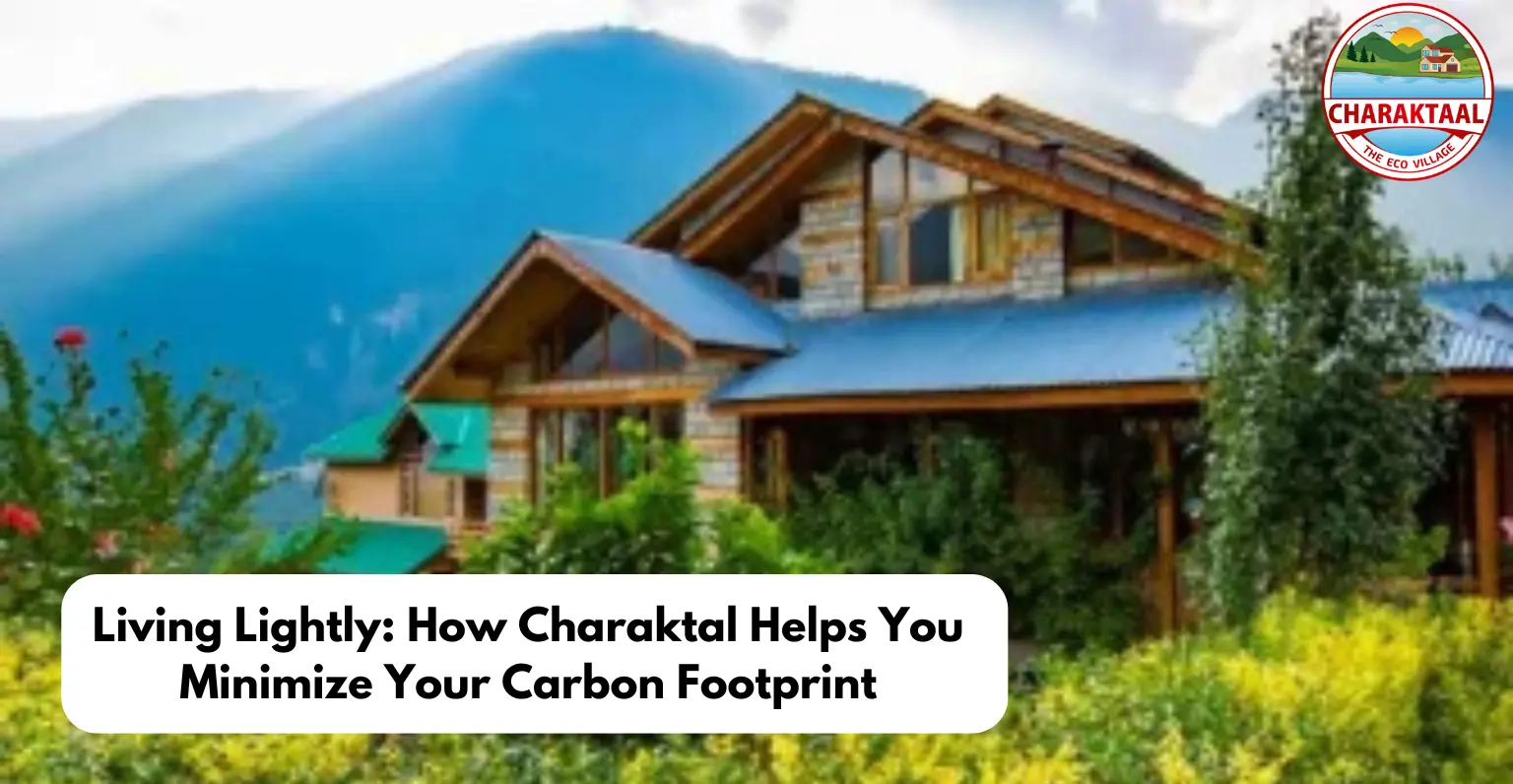
Charaktaal Eco Village sits inside that shift. The land itself is threaded with forest bathing trails—not paved walking paths bolted on as an amenity, but routes designed to move residents through the biodiversity that surrounds the community, the same kind of sustained, repeated forest contact the research associates with cumulative benefit rather than a one-off dose. Add to that the yoga and meditation deck, the organic gardens, and an open-air amphitheatre built into the landscape rather than against it, and what you get isn’t a resort experience you check into and out of. It’s an environment engineered around the exact physiological mechanism the science keeps confirming: consistent, low-effort, daily access to a forest.
The location itself does a lot of the work. Charaktaal is close enough to be genuinely reachable—around 65 km from Haridwar, roughly 120 km from Dehradun Airport, and a short run from Kotdwar’s railway station—while being far enough from the density of the plains that the air, the silence, and the biodiversity around it stay intact. Nearby, the Tadkeshwar Mahadev temple, the Durga Devi temple, Sidhbali Dham, and Kanvasharam give the region a quieter, older rhythm—this has been a place people came to slow down for a lot longer than eco-tourism has existed as a category. Corbett National Park sits within striking distance too, for residents who want their forest exposure to occasionally include a tiger.
Owning the Forest, Not Just Visiting It
There’s a specific kind of frustration familiar to anyone who has ever taken a five-day trip to the hills: you spend the first two days decompressing, the middle day actually present, and the last day already bracing for the return. The nervous system barely gets settled before it’s time to pack the car back toward the highway.
The research on forest bathing quietly reframes this problem. If a meaningful physiological reset can occur in twenty minutes, and deeper, more durable shifts occur with repeated, sustained exposure over multiple sessions, then the entire model of “nature as an occasional trip” undersells what’s actually possible. The real value isn’t a single immersive weekend a few times a year—it’s daily, low-friction access. A short walk before breakfast. An evening spent on a deck instead of a couch. The kind of exposure that only ownership, not tourism, can realistically provide.
This is the quieter argument for buying land or a home in a place like Charaktaal, distinct from the usual pitch about square footage or appreciation curves. It’s not just an asset. It’s infrastructure for your own nervous system—something a hotel booking, however well-reviewed, structurally cannot offer, because a hotel booking always has a checkout date.
Charaktaal’s plots, studios, 2 BHK Luxe Villas, and 3 BHK Sky Mansions are laid out with this in mind—wide internal roads, generous green belts, and close to 65% of the development kept as open, undeveloped land rather than paved over. It’s a deliberate ratio, and an increasingly rare one. Most hill developments treat green space as leftover land between buildings. Here, the buildings are the leftover space between the forest.
What “Wellness Real Estate” Actually Means, Beyond the Buzzword
“Wellness real estate” has become one of those phrases developers attach to a rooftop gym and call it a day. It’s worth being precise about what it should actually mean, because the difference matters for anyone making a long-term decision about where to live.
Real wellness-oriented design isn’t about adding a spa to a conventional layout. It’s about designing the environment so that the healthy choice is the default one—so you don’t have to motivate yourself into a walk, because the walk is simply what’s outside your door. Underground cabling and solar-lit common areas aren’t wellness features in the spa sense, but they matter here too: they’re what allows a community to exist inside a forest without scarring it with overhead wires and light pollution that would otherwise disrupt the very ecosystem residents are moving there to be near. Rainwater harvesting and forest bathing trails aren’t separate line items—they’re two expressions of the same underlying philosophy: build with the land’s own systems instead of against them.
This is also where the Reiki-inspired design language at Charaktaal—Choku Rei and Sei He Ki referenced as symbols of energy and clearing, the lotus as a motif of renewal—becomes more than decorative. Whatever your personal relationship to that symbolism, the underlying intention lines up with what the clinical data shows: an environment can either add to your allostatic load or subtract from it. Charaktaal’s design decisions, from the trail placement to the open green ratio, are consistently made in the direction of subtraction.
The Investment Case Nobody’s Cortisol Levels Can See—But Should
There’s also a more conventional argument sitting underneath all of this, and it deserves a straight mention. Uttarakhand’s hill markets, particularly the quieter towns still outside the reach of mass tourism, have been drawing sustained investor interest precisely because they offer what flatter, more saturated hill stations no longer can: low-density land, genuine biodiversity, and room to grow before infrastructure catches up and prices follow. A zero-pollution zone with a wellness-forward identity isn’t just pleasant to live in—it’s a differentiated asset in a real estate market where “hill view” has become a generic, overused claim on every second listing from Mussoorie to Nainital.
Buying into Charaktaal, in other words, isn’t a choice between health and financial sense. The forest that lowers your cortisol is the same forest that’s increasingly scarce, increasingly protected by geography and cantonment status from overdevelopment, and increasingly recognized as the reason land in areas like this doesn’t behave like land in areas that have already been built out.
What This Looks Like in an Ordinary Week
It’s easy for research like this to stay abstract—percentages and hormone names that are convincing on paper but hard to picture. So it helps to bring it down to something as unglamorous as a Tuesday.
In a city, a “wellness routine” usually requires active effort: waking up earlier to fit in a walk before the commute, driving to a park that’s crowded with a hundred other people trying to do the same thing, coming home to notifications that undo whatever the walk accomplished. Wellness has to be scheduled, defended, and protected from everything else competing for the same twenty minutes.
At a place built around forest bathing trails, that twenty-minute reset the research keeps pointing to isn’t a task on a list. It’s the walk to the clubhouse. It’s ten minutes on the yoga deck before the day gets going, with birdsong instead of traffic as the ambient sound. It’s dinner on a balcony that looks into tree cover instead of another building’s windows. None of it requires willpower, because none of it requires you to leave your usual day to go find it. The forest is already the commute.
This is also where a genuinely mixed-use community matters—not just as a lifestyle nicety, but because sustained forest-contact research favors repetition over intensity. A single dramatic hike into deep forest once a month doesn’t produce the same cumulative effect as brief, regular contact woven into ordinary life. The studios, villas, and mansions at Charaktaal are positioned to make that ordinary, repeated contact the default rather than the exception, with the clubhouse, amphitheatre, and children’s play area sitting inside the green belt rather than carved out separately from it.
A Different Kind of Due Diligence
If you’re evaluating a second home or a permanent move to the hills, most checklists focus on road access, water supply, title clarity, and construction quality—all of which matter, and all of which Charaktaal has been built to address, from its paved internal roads to its underground water storage and 24×7 security. But it’s worth adding one more question to that list, borrowed straight from the forest-bathing literature: what does this place actually do to my body, daily, without me trying?
Because that’s the real distinction between a house in the hills and a home in a forest. One is a structure that happens to have a nice view. The other is an environment your nervous system recognizes as safe the moment you step outside—the kind of recognition that, as it turns out, we can now measure in milligrams of cortisol per deciliter of saliva.
The science didn’t invent what the forest does. It just finally gave us the numbers to explain the exhale.
ABOUT CHARAKTAAL ECO VILLAGE
Charaktaal Eco Village is located in Lansdowne, Uttarakhand, offering plots, studios, 2 BHK Luxe Villas, and 3 BHK Sky Mansions set within forest bathing trails, organic gardens, and close to 65% open green space. To plan a site visit or ask about current availability, contact +91 92115 68264.