
There is a particular kind of exhaustion that no vacation fixes. You return from a beach resort tanned but hollow. You come back from a city break rested for exactly two days before the commute swallows you again. It is not tiredness you are feeling — it is disconnection. From quiet. From clean air. From a life that moves at the pace of seasons rather than deadlines.
Charaktaal Eco Village, nestled in the serene hills of Lansdowne, Uttarakhand, was designed specifically for people who have felt that hollow exhaustion and decided to do something permanent about it.
This is not a weekend getaway. This is a reimagining of what home can mean.
Lansdowne: The Hill Town That Chose Silence
Before understanding Charaktaal, you need to understand Lansdowne — because the two are inseparable.
Lansdowne sits at approximately 1,706 metres above sea level in the Pauri Garhwal district of Uttarakhand. Unlike Mussoorie or Nainital, it never surrendered to mass tourism. There are no neon-lit markets choking the ridge. There is no bumper-to-bumper traffic on festival weekends. The British established it as a cantonment town in 1887, and it has retained a quiet, dignified character ever since — broad oak and rhododendron forests, mist-draped mornings, and the kind of stillness that feels almost medicinal.
Charaktaal Eco Village sits approximately 25 kilometres from Lansdowne town, occupying a position that gives it the best of both worlds: the deep forest tranquillity of a secluded retreat with motorable road access that keeps the outside world reachable when you need it. Kotdwar Railway Station is the nearest rail head, Haridwar is 65 kilometres away, and Dehradun Airport is 120 kilometres from the community — far enough for peace, close enough for practicality.
This geographic balance is rarer than it sounds. Most eco-communities either compromise on accessibility (making daily life logistically painful) or compromise on seclusion (making the whole point moot). Charaktaal threads this needle with quiet precision.
The Philosophy Behind the Project: Heal, Play, Live
Real estate projects have taglines. Charaktaal has a philosophy — and the difference is everything.
The community is anchored in three Sanskrit-inflected principles that guide every design decision, every amenity, and every square metre of open space: Heal. Play. Live.
These are not marketing words. They are a sequence.
Heal comes first because the founders understood that modern urban residents arrive carrying invisible weight — chronic stress, disrupted sleep cycles, vitamin D deficiency, and the psychological toll of constant stimulation. Before you can build a new life, the old residue needs to dissolve. This is why Charaktaal incorporates organic gardens, forest bathing trails, yoga and meditation decks, and an environment deliberately free from pollution. Clean air, clean water, the sound of wind through deodar trees — these are not luxuries here. They are the baseline.
The community draws inspiration from Reiki philosophy, incorporating the Choku Rei (the symbol of power and energy) and the Sei He Ki (representing purification and protection) as guiding concepts for the spatial design. Even the lotus — that ancient symbol of life renewed each morning as it rises from still water — informs the aesthetic sensibility of the project. These are not decorative references. They reflect a genuine intention to create spaces that restore rather than merely impress.
Play follows because a healed body and settled mind naturally seek joy. Charaktaal’s open-air amphitheatre, children’s play areas, and community gathering spaces are designed for this phase — the emergence of curiosity, social connection, and the simple pleasure of having time that belongs to you.
Live is the culmination. Not survival, not routine, but the full expression of what a life can be when it is not constantly interrupted by noise, pollution, and the friction of an overcrowded city.
Inside the Eco Village: What You Actually Get
Let’s move from philosophy to the physical — because Charaktaal is as practically impressive as it is conceptually compelling.
The Property Portfolio
Charaktaal offers four distinct residential formats, ensuring that whether you are a single professional, a young family, or someone looking for a legacy property, there is an option calibrated to your needs.
Plots give you the freedom to build exactly what you envision. The land comes with paved road access (internal roads at 20, 25, and 30 feet wide), underground cabling, and water storage infrastructure already in place. You are not buying raw wilderness — you are buying a serviced canvas.
Studios are designed for those who want to arrive and simply begin. Efficient, intelligently planned, and fully embedded in the eco-village’s amenity network, studios are ideal for remote workers, creatives, or anyone who wants a foothold in the hills without the complexity of managing a larger property.
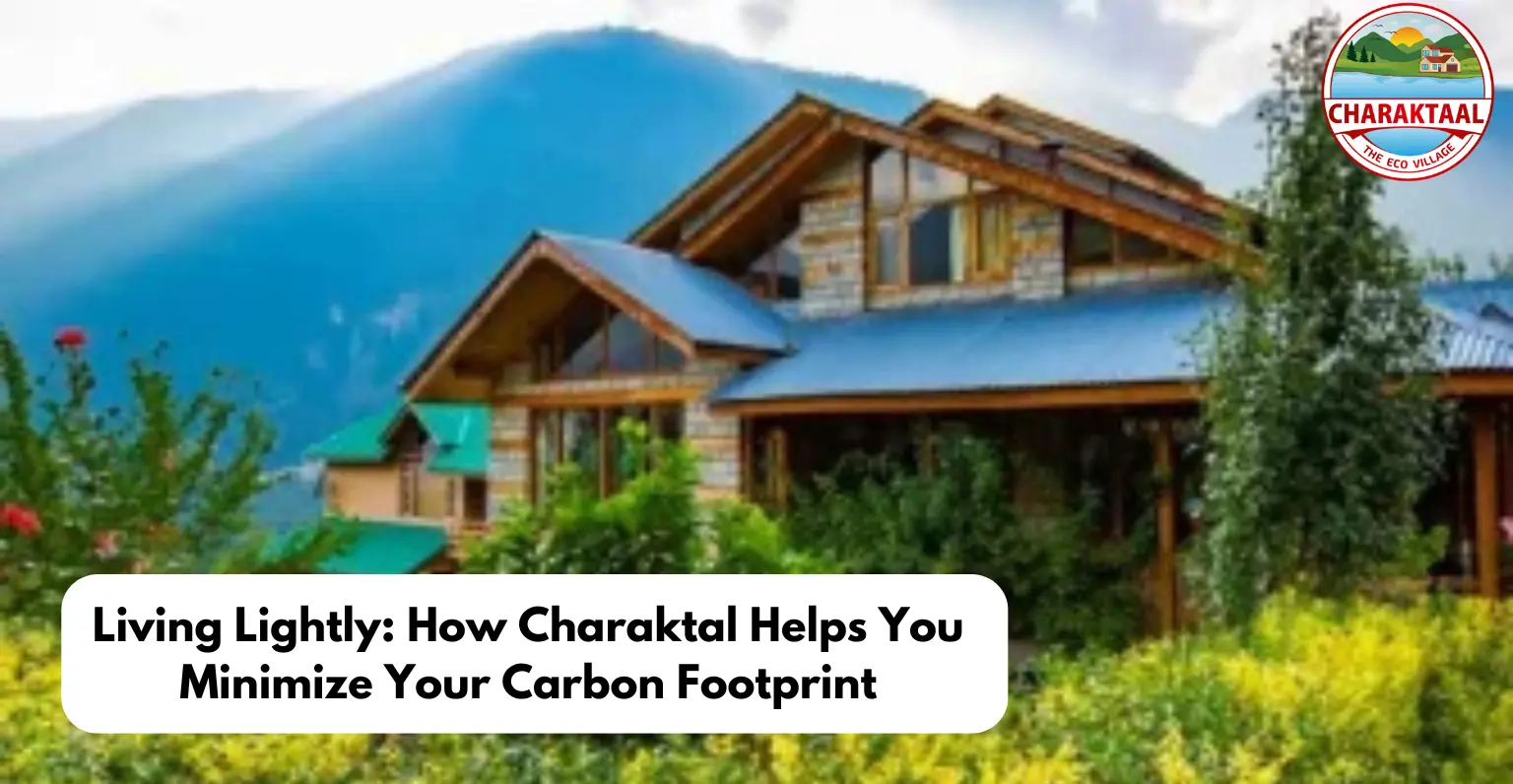
2 BHK Luxe Villas represent the sweet spot of the portfolio — spacious enough for a family, designed with the kind of material quality that ages beautifully, and positioned to take maximum advantage of the forest views and clean-air environment. These are not cookie-cutter units. Each is part of a thoughtfully zoned master plan where green belts separate zones and community spaces anchor neighbourhoods.
3 BHK Sky Mansions are the flagship offering — generously proportioned homes for those who want to make an uncompromising statement about how they intend to live. With the Himalayan foothills as a backdrop, these are properties that could exist nowhere else on earth.
The Amenity Ecosystem
What separates an eco-village from an eco-themed housing project is the depth and authenticity of its amenity ecosystem.
At Charaktaal, 66% of the project area is maintained as open green space. That is not a greenwashing figure — it is a structural commitment to the experience of living here. When you step outside your home, you step into a landscape, not a carpark.
The yoga and meditation deck sits within this green matrix, positioned to capture morning light and forest silence. Forest bathing trails — inspired by the Japanese practice of shinrin-yoku — wind through the biodiversity-rich surroundings, offering a daily ritual that research consistently links to reduced cortisol levels, improved immune function, and elevated mood.
The organic gardens serve a dual purpose: they supply fresh, chemical-free produce and they create a participatory relationship between residents and the land. There is something quietly revolutionary about growing your own food again — something that reconnects the resident to cycles of season and sustenance that urban life severs entirely.
The clubhouse with its multipurpose hall becomes the social heartbeat of the community — a place for gatherings, workshops, film screenings, or simply the kind of unhurried conversation that disappears from life when everyone is perpetually busy.
For families, the children’s play area is designed with the rare ambition of letting children actually play — outdoors, in nature, with space and freedom that urban playgrounds can never replicate.
Sustainability That Is Structural, Not Superficial
In 2026, the word “sustainable” has been so thoroughly greenwashed that it has almost lost meaning. Charaktaal earns it back the hard way — by embedding sustainability into the infrastructure rather than the brochure.
Solar-lit common areas cover 80% of shared lighting needs, dramatically reducing the community’s grid dependence while providing consistent, warm illumination through the evenings.
Rainwater harvesting systems capture the abundant Uttarakhand rainfall and convert it into a reliable local water source, reducing dependence on external supply chains and demonstrating what genuine resource sovereignty looks like at a community scale.
Underground cabling removes the visual and physical blight of overhead wires, keeping the natural landscape visually uninterrupted while also providing more reliable service during storms.
Zero pollution zone status is not aspirational here — it is the practical result of the location, the design, and the community’s commitment to maintaining the environment that makes Charaktaal worth living in.
The 65% open green space (with 66% in open areas specifically) ensures that as the community grows, it does not consume its own greatest asset. The master plan designates green belts between zones, walking circuits through the landscape, and central gathering points that preserve the feeling of living within nature rather than adjacent to it.
This is sustainability as architecture — built in, not bolted on.
The Neighbourhood: Sacred, Historic, Wild
Part of what makes a home is the world immediately beyond its walls. Charaktaal’s neighbours are extraordinary.
Jim Corbett National Park is within reach — one of India’s oldest and most celebrated wildlife reserves, home to Bengal tigers, Asian elephants, leopards, and over 600 species of birds. Living near Corbett is not a tourist footnote; it means residing in one of the most biodiverse corridors in the subcontinent.
Durga Devi Temple, nestled in the forest, carries centuries of spiritual history and remains a place of quiet devotion rather than commercial pilgrimage. For residents seeking a contemplative anchor to daily life, it is a profound asset.
Kanvasharam holds deep significance in Hindu mythology as the hermitage of Sage Kanva — the same forest where Shakuntala grew up, immortalised by Kalidasa in one of Sanskrit literature’s greatest works. Walking in this landscape is walking through living myth.
Tadkeshwar Mahadev is another ancient Shiva temple, its forest setting unchanged for centuries, offering a pilgrimage experience that feels genuinely timeless.
Sidhbali Dham in Kotdwar is one of the region’s most revered spiritual centres — widely venerated and deeply embedded in local culture.
And then there is Lansdowne town itself — with its unhurried market, colonial-era church, Army War Museum, and Bhulla Lake — offering the minor pleasures of a hill station without the crowds.
Charaktaal residents do not merely have a beautiful home. They have an entire sacred geography as their extended backyard.
The Investment Case: Why the Numbers Work
Let us be direct about money, because the investment case for Charaktaal is genuinely strong.
Lansdowne has been, until recently, one of Uttarakhand’s best-kept secrets. While property prices in Mussoorie, Nainital, and even Rishikesh have surged dramatically, Lansdowne’s deliberate quietness kept it undervalued. That window is closing.
Three forces are converging to drive property values in this region:
First, the post-pandemic permanent shift in work patterns. Remote work is no longer a pandemic accommodation — it is a structural feature of the professional landscape. This has fundamentally changed the calculus of where people choose to live, creating sustained demand for high-quality residential communities outside major metros.
Second, the wellness economy. India’s wellness real estate sector is growing at a compound annual rate that substantially outpaces conventional residential property. Eco-villages and wellness communities are not a niche — they are the leading edge of where aspirational residential demand is heading.
Third, scarcity. The combination of location (Lansdowne hills), forest density, zero-pollution status, and Charaktaal’s specific master plan cannot be replicated once the project is complete. Land adjacent to protected zones and heritage forests is finite by definition.
Charaktaal Greens, the developer, brings decades of real estate experience to the project, with a track record that includes Jusgar Resort and Eco Valley — demonstrating both the capability to deliver and the consistent commitment to ecological principles. This is not a first-time developer taking a risk. It is an experienced team executing a vision they have built toward for years.
Who Charaktaal Is Really For
It would be tempting to say Charaktaal is for everyone. It is not — and that specificity is a strength.
Charaktaal is for the family in Delhi or Gurugram that has spent years promising themselves they will “eventually” move somewhere with cleaner air, and has finally decided that eventually is now.
It is for the remote professional who has realised that the city apartment they are paying premium rent for is simply where they sleep between video calls, and that they could sleep better — and work better — somewhere that actively nourishes them.
It is for the investor who understands that real scarcity (proximity to protected forests, genuine zero-pollution status, thoughtfully planned infrastructure) is where value accumulates over time.
It is for the couple whose children are still young enough that the question of environment — the actual physical, sensory environment in which development unfolds — feels urgent and worth acting on.
And it is for the person who has stood on a hill somewhere, breathed in the forest air, felt the specific quality of that silence, and thought: I want this to be ordinary. I want this to be Tuesday.
Making It Ordinary: The Daily Life at Charaktaal
The true test of any residential community is not the brochure experience but the Tuesday experience — the texture of an average weekday.
At Charaktaal, a Tuesday looks like this: Morning light through forest-framed windows. A walk on the meditation deck before the valley wakes. Breakfast from the organic garden. Work from home in the kind of quiet that urban dwellers pay spa prices to temporarily access. An afternoon walk on the forest bathing trail. Children playing outdoors, in actual dirt, with actual trees. An evening at the amphitheatre if something is on, or simply that long horizontal conversation with a partner or friend that gets crowded out of city life.
The 24×7 security and surveillance infrastructure means this ease is not naive — it is protected. The paved internal road network means it is not rustic in the difficult sense. The solar-lit common areas mean evenings are warm and social.
This is the daily life that Charaktaal was engineered to provide — not as an aspiration, but as a baseline.
A Final Thought: The Cost of Waiting
Every year spent in a life that doesn’t fit has a cost. It is paid in air quality, in sleep, in the specific sadness of knowing something better exists and not moving toward it.
Charaktaal Eco Village in Lansdowne is not asking you to leave civilisation. It is asking you to choose a civilisation worth choosing — one built on clean air, community, ecological responsibility, and the radical conviction that home should feel like arrival, not escape.
The hills are not going anywhere. But the opportunity to be among the first residents of a community this carefully considered — to shape its culture from the beginning, to choose your plot before others do, to invest before the Lansdowne window closes — that is time-sensitive.
Come and see what Tuesday could feel like.
To learn more or book a site visit, contact Charaktaal Greens at charaktal.com or call +91 92115 68264.
Charaktaal Eco Village | Lansdowne, Uttarakhand | Where Nature Becomes Home