
There is a particular kind of clarity that arrives when you stand at the edge of a pine forest, breathing air that smells of rain and earth and something you cannot quite name — something ancient and alive. It is the clarity of knowing exactly what matters. And increasingly, across India’s cities, people are finding that clarity not in boardrooms or on trading screens, but in the hills.
Charaktaal Eco Village, nestled in the serene landscape of Lansdowne in Uttarakhand, sits at the crossroads of two powerful ideas: that land is the most enduring form of wealth, and that a truly good life is one lived in harmony with nature. These two ideas, which much of modern culture treats as opposites, are at the very heart of what Charaktaal offers — and why it represents one of the most compelling real estate opportunities in the Himalayan foothills today.
This blog is not about escaping the world. It is about choosing it differently. It is about understanding what it means to own something that grows in value not just financially, but in every dimension that a good life is measured by.
The Lansdowne Advantage: A Hill Station Still Untouched by Overcrowding
To understand why Charaktaal is special, you first have to understand Lansdowne — and why it is categorically different from the hill destinations that dominate India’s real estate headlines.
Shimla is beautiful, but choked. Mussoorie carries the weight of decades of unchecked construction. Manali and Kasol have transformed from quiet escapes into weekend traffic jams. Even Nainital, beloved as it is, struggles with the burden of its own popularity.
Lansdowne, by contrast, has preserved something rare: stillness. This small garrison town in Pauri Garhwal district sits at an elevation of roughly 1,706 metres above sea level, wrapped in oak and rhododendron forests, governed by a quiet that is increasingly hard to find anywhere in northern India. Because Lansdowne is a cantonment town — one that has been under the careful administration of the Garhwal Rifles regiment of the Indian Army for over a century — its environment has been protected with a discipline that no municipal authority could have matched. There are no malls, no neon signboards, no concrete towers eating into the skyline.
What this means for the investor and the homebuyer is significant. The natural ceiling that has kept Lansdowne uncrowded is the same force that has kept it pristine, and pristine environments in the Himalayas are growing rarer by the year. Land here is not just land — it is a share in something finite and beautiful.
Charaktaal Eco Village is located approximately 25 km from Lansdowne, far enough to offer genuine seclusion, close enough to benefit from the town’s established connectivity. It is 65 km from Haridwar and 120 km from Dehradun Airport, placing it within comfortable reach of Delhi and the NCR — a journey of roughly five to six hours that, for a growing number of urban professionals, is increasingly willingly made.
The Investment Case: What Makes Hill Eco-Real Estate a Strong Long-Term Bet
Let us talk numbers and logic before we talk poetry.
Real estate in Uttarakhand’s hill districts has followed a consistent upward trajectory over the past decade, driven by three converging forces: improving road infrastructure, rising demand for second homes and weekend retreats, and a post-pandemic shift in how Indian urban professionals think about where they want to live and invest.
The construction of the Char Dham all-weather road project, expanded NH connections to Kotdwar, and continued investment in Uttarakhand’s tourism infrastructure have all had a measurable impact on land values in the region. What was once considered remote is now accessible. What was accessible but overlooked is now sought after.
Eco-villages and intentional communities occupy a particularly interesting position in this market. They attract a buyer profile — educated, financially stable, values-driven — that tends to hold assets longer, maintain properties better, and contribute to the long-term appreciation of a project’s character. When you invest in a development like Charaktaal, you are not just buying a plot of land; you are entering a curated ecosystem of like-minded people whose collective care for the community is itself a form of value protection.
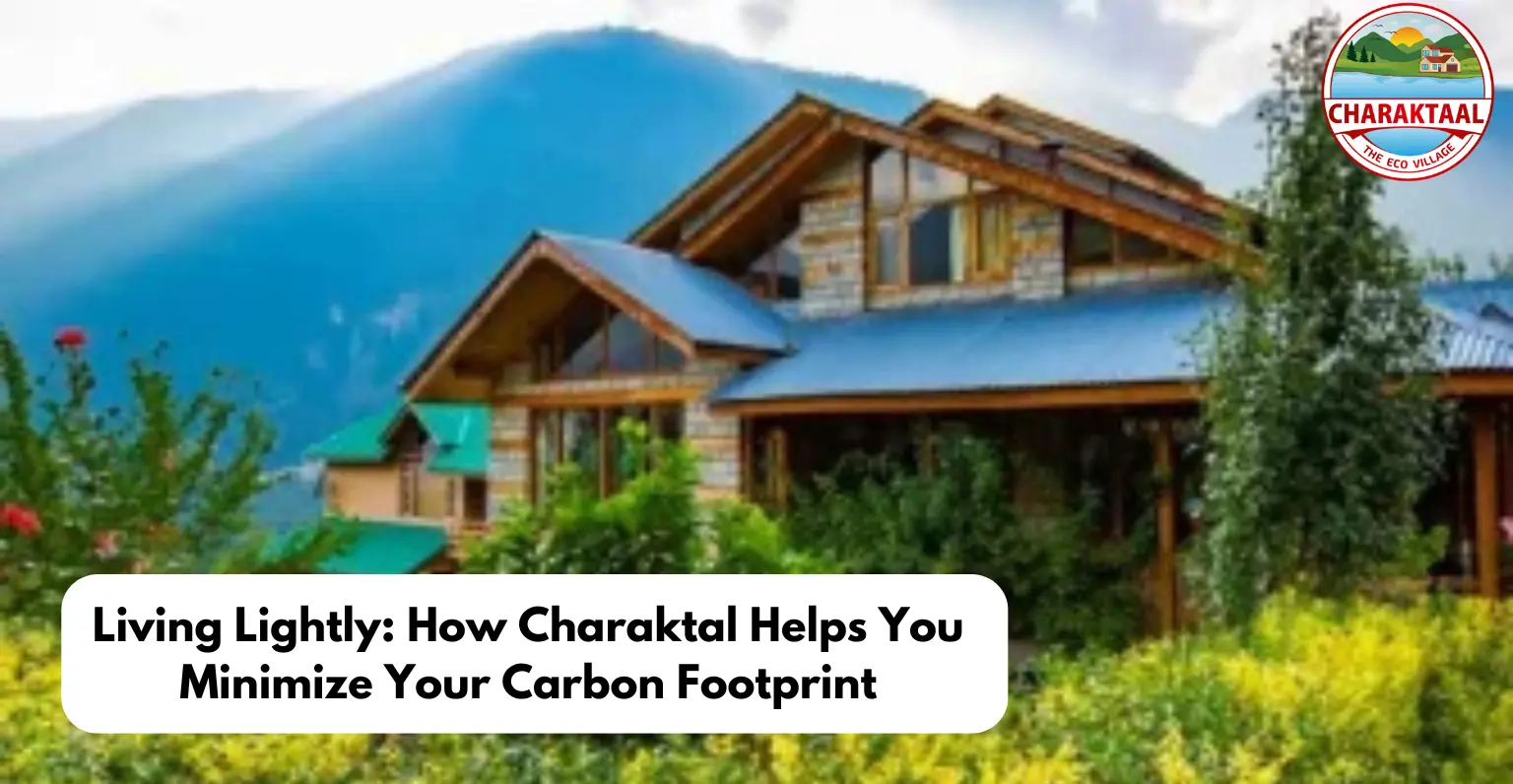
Charaktaal’s master plan is built around this logic. The development offers plots, studios, 2 BHK Luxe Villas, and 3 BHK Sky Mansions across a landscape where 65% of the total area is maintained as open green space. This is not a number chosen for marketing appeal — it is a design philosophy. Higher green coverage means lower density, which means quieter surroundings, cleaner air, and a living environment that does not depreciate with age. In most real estate developments, time is the enemy of ambience. In an eco-village designed with this level of intentionality, time becomes an ally.
The infrastructure at Charaktaal is built to last and built to sustain: wide internal roads at 20, 25, and 30 feet; underground cabling to eliminate the visual clutter of overhead wires; 24×7 security with CCTV surveillance; solar-lit common areas; rainwater harvesting systems; and underground water storage. These are not optional features — they are the bones of a development that was planned with permanence in mind.
For the NRI investor or the Delhi-based professional looking to diversify beyond equities and urban apartments, a property in Charaktaal offers something that most financial instruments cannot: the combination of tangible appreciation, regular rental income potential from eco-tourism and short-stay guests, and a deeply personal value that compounds with every visit.
The Ancient Wisdom Behind the Modern Eco-Village
Charaktaal is not merely a real estate project that happens to be surrounded by trees. Its philosophy runs deeper than that, rooted in healing traditions that have guided human relationship with nature for centuries.
The Charaktaal Mantras draw on Reiki — the Japanese art of energy healing that works on the principle that life force energy flows through all living beings, and that when this energy is in balance, health, clarity, and wellbeing follow naturally. Two of Reiki’s most powerful symbols form the spiritual backbone of Charaktaal’s vision: Choku Rei, the symbol of power and energy, and Sei He Ki, the symbol of purification, protection, and clearing.
These are not decorative ideas. They reflect a genuine intention: that the space you inhabit should actively support your health, not merely shelter you from the elements. The placement of wellness zones, the orientation of community spaces, the choice of natural materials, the preservation of forest corridors — all of these design decisions are informed by a sensitivity to how environments affect people at levels that go beyond the visual or the material.
The lotus flower, another of Charaktaal’s guiding symbols, speaks to the same truth in a different language. The lotus emerges from murky water each morning in full bloom, a natural metaphor for renewal — for the capacity of living things to rise above their surroundings, purified and radiant. This is the aspiration embedded in Charaktaal’s identity: not just a beautiful place, but a regenerative one.
In Ayurvedic tradition, the concept of Vastu Shastra — the ancient Indian science of spatial arrangement — holds that the way a space is oriented and constructed directly affects the energy, health, and fortune of those who inhabit it. While Charaktaal does not market itself as a Vastu project in narrow terms, the broader principle is alive in its design: that thoughtful architecture in relationship with natural surroundings creates conditions for human flourishing that go beyond what square footage and bedroom counts can capture.
Forest Bathing, Biodiversity, and the Science of Healing Landscapes
There is a body of scientific research — much of it emerging from Japan, Scandinavia, and increasingly from Indian institutions — that documents what people who have lived close to forests have always known intuitively: that time in nature measurably improves human health.
The Japanese practice of Shinrin-yoku, or forest bathing, has been studied extensively and shown to reduce cortisol levels, lower blood pressure, improve immune function, and lift mood in ways that are statistically significant and clinically reproducible. It is not about exercise. It is not about meditation in the conventional sense. It is simply the act of being present in a forest environment — breathing the phytoncides released by trees, listening to birdsong, feeling the temperature differential between sunlit clearings and shaded groves.
Charaktaal’s forest bathing trails are not an amenity tacked onto a real estate brochure. They are the product of a genuine understanding that the most valuable thing a development in this landscape can offer its residents is structured, intentional access to the healing power of the forest that surrounds it.
The biodiversity of the Lansdowne region adds another dimension. The forests here are home to a range of bird species that draw ornithologists and nature photographers from across the country. The surrounding Pauri Garhwal district forms part of the buffer zone of Corbett National Park — one of India’s oldest and most celebrated wildlife reserves, just a comfortable drive from Charaktaal. Residents and visitors can access a natural world of extraordinary richness without leaving the region.
This ecological richness is not merely scenic. Biodiversity correlates with ecological health, and ecological health correlates with the quality of air, water, and soil that sustains a community. When Charaktaal commits to preserving and expanding green cover within its boundaries, it is making an investment in the biological capital that makes life here genuinely different from urban life — not just aesthetically, but physiologically.
Building Community: The Invisible Infrastructure That Matters Most
One of the things that distinguishes an eco-village from a gated residential colony is the explicit intention to build community — not just to provide shared walls and a common maintenance bill, but to create conditions under which neighbours become something closer to a village.
Charaktaal’s design embeds this intention in concrete ways. The open-air amphitheatre is designed for performances, festivals, and gatherings — the kind of shared experiences that create the social memory a community lives on. The clubhouse with its multipurpose hall provides space for workshops, classes, and the informal meetings that deepen relationships over time. The organic gardens are not just a source of fresh produce; they are shared labour, shared pride, and shared conversation.
There is something particular about the experience of working in soil alongside your neighbours, of watching seeds become vegetables, of eating food that you helped grow. It connects people to each other and to the land in a way that no amenity list can fully capture, but that anyone who has experienced it recognises immediately as irreplaceable.
The yoga and meditation deck at Charaktaal is another such space — one that is most alive not when a single person uses it in solitary practice, but when a small group gathers at sunrise to breathe and move together before the day begins. This is the texture of life in an intentional community, and it is something that Charaktaal’s designers have built into the bones of the project.
Children’s play areas complete a picture that is, at its heart, about intergenerational life — about creating a place where grandparents can walk safely in the evening, where children can roam more freely than in any city apartment complex, where the rhythms of family life have space to unfold at a human pace.
The Heal-Play-Live Philosophy: A Framework for Wholeness
At the centre of Charaktaal’s identity is a three-part philosophy that its founders have expressed with elegant simplicity: Heal. Play. Live.
Each of these words carries more weight than its brevity suggests.
Heal is the recognition that most of us arrive at a place like Charaktaal carrying something that needs to be set down. The accumulated stress of urban life, the fatigue of constant connectivity, the low-grade anxiety of environments that prioritise productivity over personhood — these are real conditions, and they respond to real remedies. Organic food grown without chemicals, clean air that fills the lungs completely, water stored and distributed without compromise — these are not luxuries. They are, as Charaktaal’s philosophy puts it, “nature’s true elixir.”
Play is the acknowledgment that human beings are not merely workers or investors or parents or patients. We are also creatures who need to move for joy, to explore without agenda, to be surprised by what we find around the next bend in a trail. Charaktaal’s surroundings — the forests, the hillsides, the proximity to Corbett, the trails that wind through pine and oak — are a playground for adults who have forgotten that play is as essential to a full life as work.
Live is perhaps the most quietly radical of the three. In a culture that often conflates living with achieving, Charaktaal invites a different understanding: that to live well is to inhabit your life fully, to be present to its textures and relationships and small dailiness. A walk through Charaktaal at dusk, with the light dropping behind the ridgeline and the air cooling and the first stars appearing above the treeline, is a complete experience in itself. It does not need to be documented, optimised, or monetised to matter.
A Note on the Nearby Temples: Spiritual Geography of the Region
The land around Charaktaal carries centuries of spiritual significance that adds an intangible but deeply felt dimension to the experience of living here.
The Durga Devi Temple in the region is one of several ancient shrines that dot the hillsides, drawing pilgrims and seekers who have been finding their way to these forests for generations. Kanvashram, the ashram associated with the sage Kanva — where, in the classical tradition, Shakuntala spent her childhood — sits in a forest setting that has preserved a sense of sacred quiet that urbanisation has not yet reached. Tadkeshwar Mahadev, a Shiva temple set in deep forest, offers the particular kind of peace that belongs to places where devotion has been practised continuously for many centuries.
Sidhbali Dham, another significant temple in the broader region, draws visitors from across Uttarakhand, reminding newcomers that the hills around Charaktaal are not empty — they are full of a living, breathing spiritual culture that the land itself seems to sustain.
For many buyers and residents, this proximity to sites of spiritual significance is not incidental. It is part of what makes this corner of Uttarakhand feel like more than real estate — it feels like a place that has been held, tended, and valued by human beings for a very long time.
Who Is Charaktaal For?
It would be easy to say Charaktaal is for everyone, but that would miss the point. Charaktaal is specifically, deliberately designed for people who have come to a particular reckoning — who have measured the trade-offs of urban life and decided that the balance has shifted.
It is for the IT professional in Gurugram who has spent fifteen years building financial security and is now ready to build something that cannot be captured in a portfolio statement. It is for the retired couple who want their next chapter to unfold in clean air rather than a city apartment. It is for the young family that wants their children to grow up knowing what a forest smells like after rain. It is for the NRI in London or Dubai or Singapore who keeps dreaming of a home in the hills that is rooted, safe, and real.
It is also, straightforwardly, for the investor who recognises that Lansdowne-adjacent eco-real estate in the lower Himalayas is at an inflection point — that the combination of improving infrastructure, rising demand, and finite supply is creating conditions for significant appreciation in the years ahead.
Conclusion: The Wealth That Grows With You
There is a phrase embedded in Charaktaal’s philosophy — “nature’s true elixir” — that keeps returning when you sit with what this place is trying to offer. An elixir is not a quick fix. It is something that works at a deep level, over time, changing the conditions that allow life to flourish.
That is what Charaktaal is: not a product, but a condition. A condition in which your investment grows because the land is scarce and beautiful and increasingly sought after. A condition in which your health improves because the air and food and environment actively support it. A condition in which your relationships deepen because the design of the community brings people together rather than keeping them apart.
The best investments are the ones that align what is financially wise with what is humanly true. Charaktaal makes that alignment possible — a place where the land you own is also the landscape you inhabit, where the asset on your balance sheet is also the ground beneath your feet, and where the returns compound not just in your account, but in the quality and depth of your daily life.
The hills of Lansdowne are waiting. The forests are already there. The community is being built, plot by plot, by people who have chosen differently.
The only question is whether you are ready to choose too.
To learn more about plots, studios, villas, and investment opportunities at Charaktaal Eco Village, visit charaktal.com or call +91 92115 68264.