
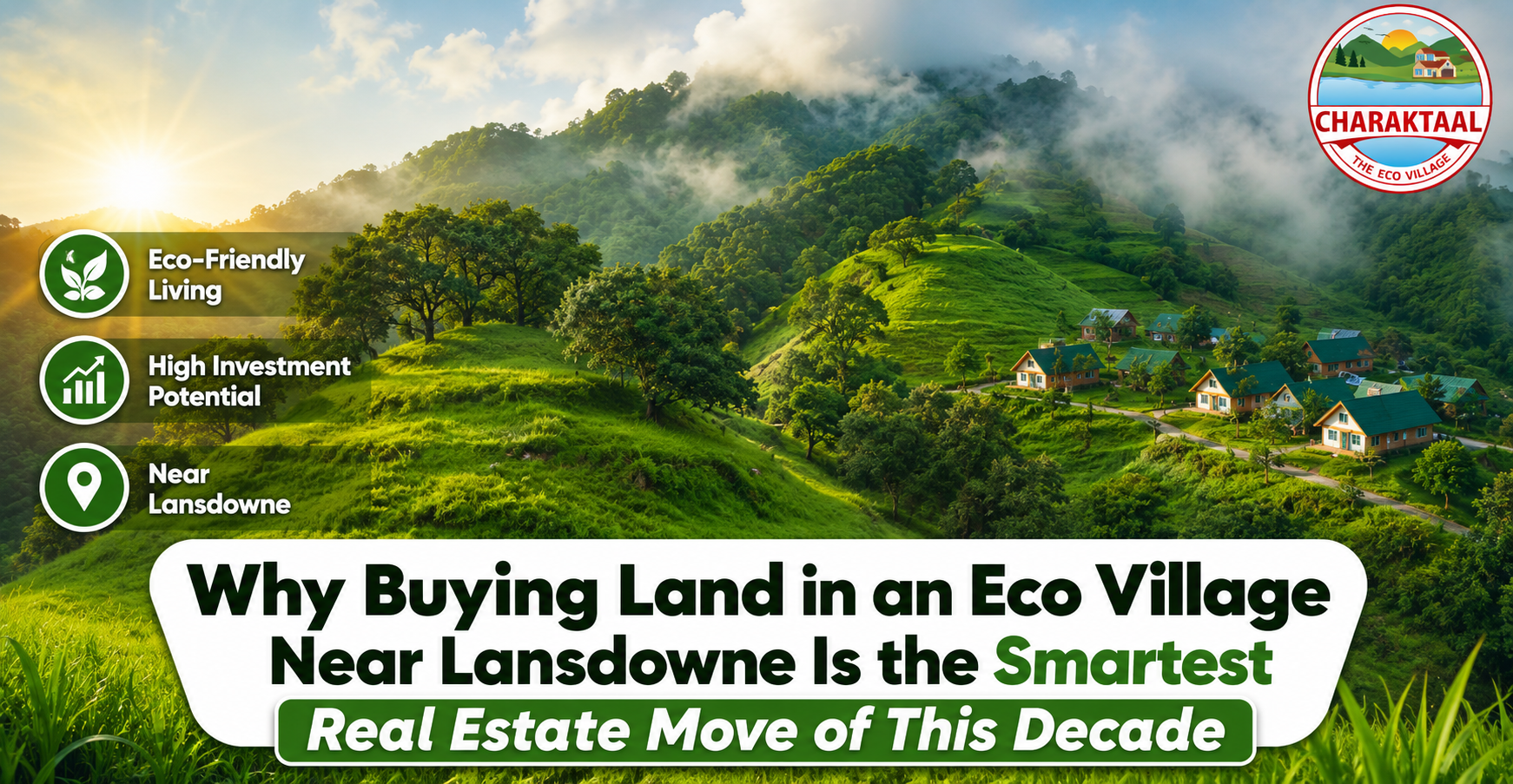
There is a particular kind of clarity that comes when you stand on a hillside in the Pauri Garhwal region of Uttarakhand — oak canopy overhead, a breeze carrying the scent of pine resin, and a silence so complete you can hear your own thoughts for the first time in months. For most people visiting Lansdowne and its surrounding valleys, that moment arrives as a revelation: this is what I have been missing.
For a growing number of discerning investors and home-seekers, that revelation quickly becomes a question: Can I make this permanent?
The answer, increasingly, is yes — and the case for doing so has never been more compelling, financially or otherwise.
The Quiet Shift Happening in Indian Real Estate
Indian real estate has always followed population density. Demand clusters around metros, then tier-2 cities, and now — for the first time in modern property history — a meaningful third wave is emerging: demand for intentional, nature-integrated living spaces far removed from urban congestion.
This is not a niche hobby for the wealthy. It is a structural shift, driven by several forces converging at once.
Remote and hybrid work has untethered a significant portion of India’s professional class from the requirement of physical proximity to office towers. A software engineer in Gurugram, a consultant in Mumbai, a designer in Bengaluru — all of them can now work from a hilltop in Uttarakhand with the same professional effectiveness they had from a flat in Noida. What they gain in the exchange is everything the city could not give them: clean air, space, quiet, and a relationship with the natural world that urban environments structurally cannot provide.
At the same time, health has moved from a background concern to a front-of-mind priority for an entire generation of Indians. The lived experience of watching cities become unhealthy places — whether measured in AQI readings, commute-related stress, or the creeping exhaustion of overstimulated living — has given people a concrete, personal reason to seek alternatives. The eco-village model, once viewed as fringe, now reads as foresight.
And then there is the financial dimension, which deserves far more serious attention than it typically receives.
The Investment Case: Why Eco-Village Land Near Lansdowne Makes Financial Sense
Conventional real estate wisdom says: buy where infrastructure is already built, where prices are already high, where everyone else has already arrived. This logic has made many developers wealthy and most buyers pay for someone else’s early entry.
Contrarian real estate wisdom — the kind that actually builds wealth — says something different: buy where the trajectory is clear but the pricing hasn’t caught up yet.
The Lansdowne-Kotdwar belt of Pauri Garhwal sits squarely in that second category.
Improving Connectivity Is a Price Multiplier
The National Highway connecting Kotdwar to Lansdowne and beyond has seen continued investment in recent years, reducing effective travel time from Delhi NCR significantly. Kotdwar railway station connects directly to major North Indian cities. The upcoming improvements to road infrastructure across the Garhwal foothills — a consistent policy priority for the Uttarakhand state government, which has tied tourism and real estate development to its growth strategy — will systematically erode the distance premium that currently keeps land prices modest.
History is instructive here. Look at what happened to property values in Rishikesh after NH 58 upgrades. Look at Mussoorie corridor pricing before and after connectivity improvements in the 2000s. The pattern is consistent: once the friction of distance reduces, pricing accelerates, and early entrants capture disproportionate gains.
At present, land near Lansdowne is priced with current connectivity assumptions baked in. That is a window, and windows close.
Tourism Demand Creates a Dual Asset
A property in an eco-village near Lansdowne is not a single-use asset. Unlike a flat in Noida that generates rental yield only when occupied by a long-term tenant, an eco-village plot or villa can generate income through short-stay tourism at rates that are meaningfully higher per night than urban residential yield.
Uttarakhand received over 45 million tourist visits in 2023, with hill stations in the Pauri Garhwal region seeing consistent year-on-year growth in footfall. Demand for curated, nature-immersive stays — as opposed to standard hotel accommodation — has been growing especially fast. Platforms facilitating homestay and boutique property rentals have documented a sustained premium for properties offering what travelers increasingly call “authentic” experiences: clean air, natural surroundings, locally grown food, and genuine quiet.
An eco-village property can be used personally during preferred seasons and let out during peak tourism periods, creating a dual-return structure that urban real estate simply cannot replicate.
Land Is Finite, Stress Is Infinite
There is a supply argument here too. The hills of Uttarakhand are not getting larger. Regulations governing forest land and ecological buffer zones limit developable land significantly. Well-planned communities — those that have already navigated the regulatory environment, secured clear title, and developed infrastructure — represent a finite and shrinking inventory.
The alternative for future buyers who wait is either higher prices for equivalent properties or compromised options that lack the planning, green space, or community design they wanted. The opportunity cost of waiting is real.
What Makes a Planned Eco Village Different From Simply Buying a Plot in the Hills
This distinction matters enormously, and it is where many buyers make costly errors.
Buying raw land in the hills sounds romantic and often is — until the realities of developing it become apparent. Secure water access, road construction, power connections, waste management, and the basic infrastructure of habitable living represent substantial capital expenditure beyond the land cost. In remote areas, this can easily exceed the land purchase price itself.
A thoughtfully planned eco-village like Charaktaal addresses this problem fundamentally. The infrastructure is not an afterthought — it is the product.
Wide internal roads (20-foot, 25-foot, and 30-foot paved carriageways) mean vehicle access across seasons, including the Uttarakhand monsoon when unpaved tracks become impassable. Underground cabling eliminates the aesthetic and practical problems of surface utility lines. Secure water storage with backup provisions handles the supply variability common in hill regions. Solar-lit common areas reduce operational costs while honoring the ecological values that brought people to the hills in the first place.
Rainwater harvesting systems close the water cycle on-site, reducing dependence on external sources and giving the community genuine resilience. These are not decorative features — they are the engineering foundation of a property that will actually function well across seasons, year after year.
The gated security and CCTV infrastructure matters too, particularly for investors who will not be on-site continuously. Knowing that a property is professionally managed and monitored changes the investment calculus meaningfully.
The Wellness Economy Is Not a Trend — It Is a Structural Shift in What People Value
For decades, the Indian middle class measured prosperity in square footage per floor, in city-view apartments, in proximity to commercial centers. The aspiration was upward, literal and metaphorical: higher floors, higher density, higher stimulation.
Something has changed. The generation currently in its prime earning years — 35 to 55 — has lived through enough urban intensity to know what it costs. They have the data: rising rates of lifestyle disease, anxiety, sleep disorder, and the particular exhaustion that comes from chronic overstimulation. They have access to research on what the natural environment does for human physiology: lower cortisol, improved sleep architecture, enhanced immune function, demonstrably better mental health outcomes.
They are also, for the first time, financially in a position to act on this knowledge rather than defer to it.
The eco-village model is the response to this shift. It is not about renouncing modern comfort — the era of eco-living as hair-shirt deprivation is long past. It is about restructuring what comfort means. Comfort as clean air at sunrise. Comfort as a morning walk through forest without navigating traffic. Comfort as a meal grown in proximity to where it is eaten. Comfort as a community of people who chose to be here for reasons that go beyond real estate speculation.
At Charaktaal, this philosophy is embedded in the physical design. Yoga and meditation decks are not amenity boxes ticked on a marketing brochure — they are the natural expression of a community whose members understand that wellness requires dedicated space and intentional design. The organic garden provisions mean that food sovereignty is available to those who want it. Forest bathing trails — the practice of Shinrin-yoku, now extensively documented in medical literature for its measurable effects on immune and neurological function — exist not as a novelty but as a daily resource.
The club house, the amphitheatre, the children’s play area: these create the social infrastructure that urban apartment complexes promise but rarely deliver. When a community is built around shared values — ecological consciousness, mindful living, appreciation for natural beauty — the social fabric it produces is genuinely different from a collection of apartments whose only shared characteristic is a postal code.
The Spiritual Geography of This Corner of Uttarakhand
Real estate valuation rarely accounts for what might be called spiritual geography — the invisible qualities of a place that determine whether living there feels meaningful. In Uttarakhand, this dimension is unusually tangible.
The region surrounding Lansdowne and the Kotdwar-Garhwal belt carries centuries of pilgrimage history. The Durga Devi Temple, set in natural surroundings that give the visit a quality entirely distinct from urban temple-going, has drawn devotees for generations. The Kanvashram site along the Malini river carries associations that stretch back into classical Sanskrit literature — this is the ashram where, according to the Mahabharata, Shakuntala was raised by sage Kanva. The Tadkeshwar Mahadev temple, the Sidhbali Dham — these are not tourist attractions so much as nodes in a spiritual landscape that has been inhabited and sanctified by human attention for a very long time.
Living in proximity to places like these does something to a person’s sense of time and meaning that is difficult to articulate and easy to underestimate. The urgency that urban life manufactures begins to dissolve. Priorities clarify. The question “what actually matters?” becomes easier to answer — or perhaps more accurately, it becomes possible to hear the answer.
For buyers considering an eco-village investment, this is not a soft consideration. It is often the one that tips a decision from “sensible investment” to “this is where I want my life to go.”
Understanding the Offerings: What Charaktaal’s Master Plan Provides
The master plan at Charaktaal is designed to accommodate different needs, stages of life, and investment profiles — which is a meaningful differentiator from single-format developments.
Plots offer maximum flexibility: the ability to design and build a home that expresses the owner’s specific vision, in their own time, at their own pace. For buyers who have clear ideas about architecture and want creative control, plot ownership is the right starting point. The existing infrastructure — roads, utilities, security, green belts — removes the hardest challenges while preserving full design freedom.
Studios represent the entry point for those whose primary use case is a personal retreat: weekend escapes, extended working holidays, a base for Uttarakhand exploration. Well-designed studios in eco-village settings have proven to be highly lettable as short-stay properties, with occupancy rates that can support meaningful yield even for owners who use the property personally for part of the year.
2 BHK Luxe Villas answer the need for a full-time residence or substantive family retreat. The design intention — luxury in materials and finish, placed within a landscape of natural beauty — reflects an understanding that moving to the hills does not require abandoning quality. These are homes for people who have chosen nature without choosing to compromise on how they live within it.
3 BHK Sky Mansions represent the apex of what the project offers: generous living space, premium specification, and a sense of arrival that suits those for whom the eco-village is a primary home rather than a secondary property.
The zoning of these different product types within the master plan, separated by green belts and connected by wide roads, gives the community a coherent spatial logic. This is not a subdivision where plots were sold without imagination — it is a community that was designed.
What the Numbers Look Like
Without being specific about current pricing (which changes and is best confirmed directly with Charaktaal’s team), the structural argument for value appreciation is clear.
Current pricing reflects today’s connectivity, today’s awareness, and today’s level of infrastructure completion. Each of these will improve over time. The road network in Pauri Garhwal will be upgraded. Awareness of Lansdowne as a destination — already growing steadily — will continue to spread. Infrastructure at Charaktaal will be progressively completed, moving the project from plan to reality.
Each of these improvements historically correlates with price increases. Early buyers at comparable Uttarakhand hill projects have seen appreciation that meaningfully outperforms urban residential benchmarks over five-to-ten year horizons — with the additional advantage of having a usable, enjoyable asset during the holding period rather than a vacant investment flat in a speculative township.
The key metric for evaluation is not just capital appreciation potential, but the combination of: (1) personal utility during ownership, (2) rental income potential during unused periods, and (3) appreciation trajectory. Eco-village properties near established hill towns like Lansdowne score well on all three.
A Decision That Works on Multiple Levels
The best investments are the ones that make sense across multiple dimensions simultaneously.
Financially, land in a well-planned eco-village near Lansdowne offers early-mover advantage, dual-use income potential, and exposure to a property category that is growing in demand faster than supply can accommodate it.
Personally, it offers what no urban investment can: a place to go when the city becomes too much. A place where the air is clean, the mornings are quiet, and the evening sky has not been occluded by light pollution. A place where children can grow up with direct contact with the natural world — a developmental input that research increasingly shows has lasting effects on cognitive flexibility, emotional regulation, and creativity.
And philosophically, it is an alignment of capital with values — a way of putting a stake in the ground, literally, for a vision of life that prioritizes health, meaning, and connection to the world as it actually is: not concrete and screens, but soil and sky.
The question is not whether properties like Charaktaal represent a good opportunity. The question is whether the moment of decision arrives before the window closes.
For those drawn to Lansdowne’s hills, the answer is available in the quality of the air on arrival and the reluctance to leave on departure. The land is ready. The question is whether you are.
For more information about plots, studios, villas, and sky mansions at Charaktaal Eco Village, Lansdowne, Uttarakhand — or to schedule a site visit — contact Charaktaal Greens at +91 92115 68264 or visit charaktal.com.