
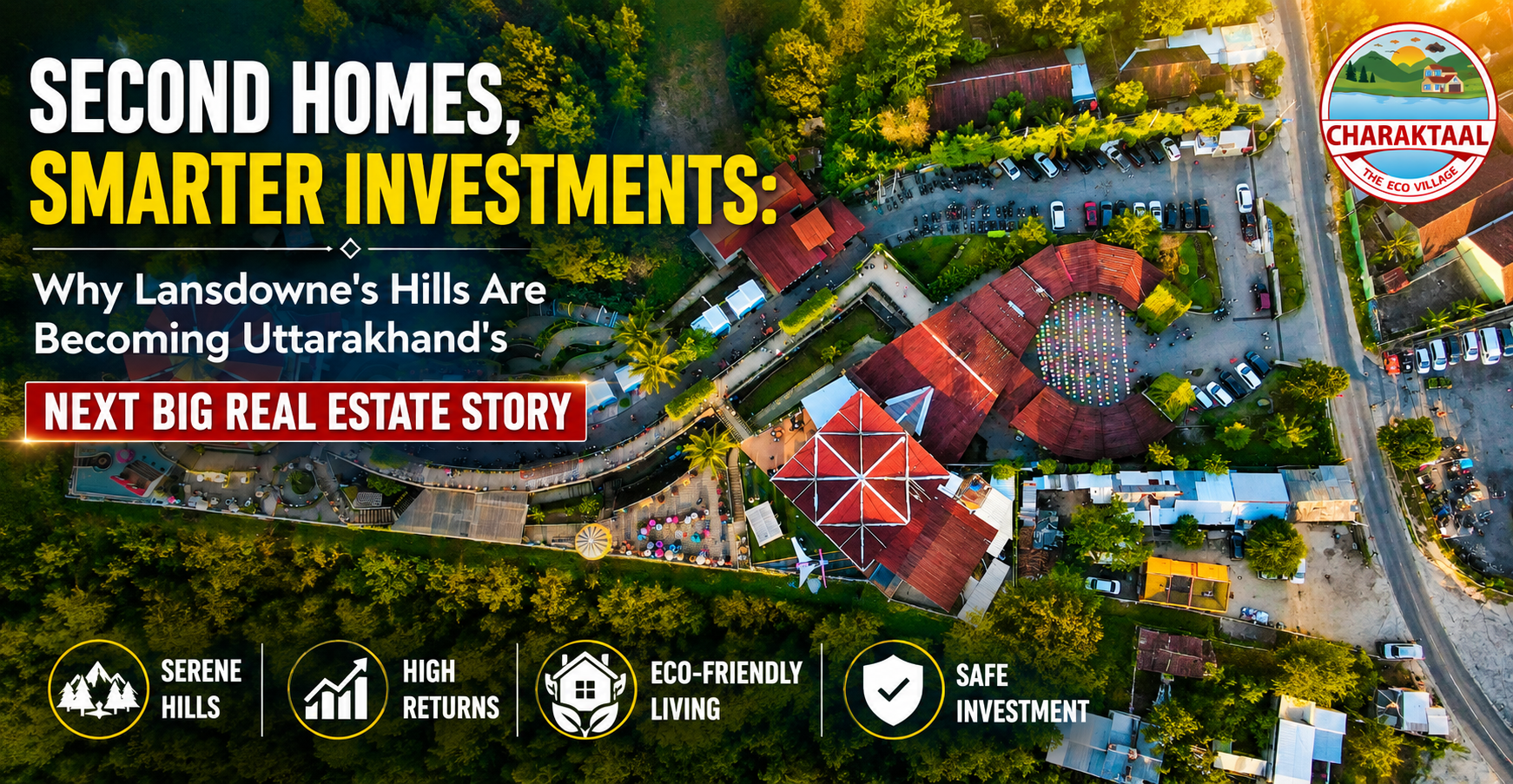
For decades, the idea of a “second home” in India meant one thing: a small flat in a crowded hill station, used twice a year, gathering dust the rest of the time. That idea is changing fast. Today, a second home is increasingly being viewed the way investors view any other asset — for appreciation, for rental income, for diversification, and for the lifestyle dividend that comes bundled in. And nowhere is this shift more visible than in the quiet, pine-covered hills of Lansdowne, Uttarakhand, where a new kind of real estate is emerging — planned, sustainable, and built for people who want their money and their wellbeing to grow at the same time.
This piece looks at why hill real estate, and Lansdowne in particular, is attracting a new wave of serious buyers — and what to actually look for if you’re considering a plot, studio, or villa in the hills as your next investment.
The Second-Home Market Has Changed Character
Until recently, second homes in India were largely an emotional purchase. A family bought a cottage near a hill station because they loved the place, not because they expected it to outperform a mutual fund. That calculus has shifted for three reasons.
Remote and hybrid work made location optional. When a meaningful chunk of white-collar work can be done from anywhere with a stable internet connection, the question “where do I want to live and work from” opened up dramatically. A property eight hours from Delhi that once felt impractical for anything beyond a weekend trip now looks viable for weeks-long stays, especially with India’s hill towns steadily improving broadband and road infrastructure.
City living costs have caught up with city living benefits. Real estate prices in Delhi-NCR, Gurugram, and other metros have risen sharply, while air quality, traffic, and density have made daily life noticeably harder. For many buyers, the calculation isn’t “city home versus hill home” anymore — it’s “how do I split my life and my capital between the two.”
Land in the hills is finite in a way that land in the plains isn’t. Hill states like Uttarakhand have strict topographical and ecological limits on how much can be developed, and increasingly tight regulation on construction in sensitive zones. That scarcity, combined with rising demand, is precisely the kind of supply-demand imbalance that tends to support long-term price appreciation — provided the land itself is legally clean and properly developed.
Put together, these forces have turned hill property from a sentimental purchase into a genuine asset class. And within that asset class, a few specific locations are pulling ahead of the rest.
Why Lansdowne, Specifically
Uttarakhand has no shortage of hill destinations — Mussoorie, Nainital, and Almora are all well known, and all are, frankly, already crowded and expensive. Lansdowne occupies a different position on the map, and that position is exactly what makes it interesting right now.
It’s a cantonment town, which has quietly protected it. Because a part of Lansdowne falls under military administration, large-scale unchecked construction never took hold the way it did in some neighbouring hill stations. The result, even today, is cleaner air, lower density, and forest cover that hasn’t been chipped away by decades of haphazard building.
It’s close enough to be practical, far enough to stay quiet. Lansdowne sits roughly 65 km from Haridwar and about 120 km from Dehradun Airport — close enough for a weekend drive from the plains, or a same-day flight-and-drive from Delhi, but far enough that it hasn’t been absorbed into the day-trip tourist circuit the way some closer hill towns have.
The natural surroundings are still genuinely wild. The region around Lansdowne backs onto forested ridgelines with real biodiversity — not manicured parks, but actual pine and oak forest, streams, and wildlife corridors. Nearby points of interest include the Durga Devi Temple, Tadkeshwar Mahadev, Sidhbali Dham, the historic Kanvasharam, and Bhulla Lake, with Jim Corbett National Park within reach for a day trip. That combination of heritage sites, temple circuits, and wilderness is rare to find within a single, compact catchment area.
Infrastructure is improving without the area losing its character. Roads, water systems, and connectivity into the region have been steadily upgraded in recent years, which matters enormously for property value — a beautiful plot with no usable access road is a liability, not an asset. Lansdowne is at the stage where infrastructure has caught up enough to make development viable, but land prices haven’t yet caught up to reflect that — which is usually where the best entry points lie.
This is the broader context in which a development like Charaktaal Eco Village has emerged — not as an isolated project, but as part of a real shift in how and where people are choosing to put down roots in the hills.
From Holiday Cottage to Financial Asset: How to Actually Think About the Numbers
If you’re evaluating a hill property as an investment rather than purely a getaway, the framework is a little different from urban real estate. A few factors matter disproportionately.
Land appreciation versus rental yield. In most Indian hill markets, the bulk of the return on a second home comes from land and property appreciation over a 5–10 year horizon, not from rental yield in the short term. That said, well-located properties with good road access and a genuine wellness or tourism draw can generate meaningful income through short-term rentals, especially during peak season (March–June and September–November in most of Uttarakhand), and increasingly through long-stay “workation” bookings in the shoulder months.
Plot versus built property. A plot is the most flexible and often the most capital-efficient entry point — you control the timeline and design of construction, and undeveloped land in a well-planned community tends to appreciate fastest as the surrounding infrastructure matures. A built villa or studio, on the other hand, gives you an income-generating or immediately usable asset from day one, at a slightly higher upfront cost. Neither is inherently better; the right choice depends on whether you want flexibility or immediacy.
Density and master planning matter more than the view. A breathtaking view attached to a project with no clear road-width plan, no defined green belt, and no governance structure for shared spaces is a much weaker investment than a slightly less dramatic plot inside a properly zoned, gated development with 20–30 ft internal roads, underground cabling, and demarcated community land. Buyers often underweight this until they’ve actually tried to get a water connection sorted in an unplanned hill settlement.
Sustainability features aren’t just ethics — they’re economics. Solar-lit common areas, rainwater harvesting, and underground utilities reduce a property’s long-term running costs and reduce its exposure to the erratic municipal infrastructure that affects a lot of older hill settlements. As buyers become more sophisticated, eco-credentials are increasingly priced into resale value, the same way they have been in commercial real estate for years.
A Quick Due-Diligence Checklist for Hill Property
Before any hill land purchase — at Charaktaal or anywhere else — it’s worth running through a short list of questions that experienced hill-property buyers always ask:
- Is the title clear and the land use legally permitted for the kind of construction you intend? Hill states have specific land-use and construction regulations, and these vary by zone.
- Is there a usable, motorable approach road, and who maintains it? A plot with no formal road access can be effectively worthless for construction purposes, regardless of how attractive the location looks on a map.
- What’s the actual water source, and is it secured for the long term? Water scarcity is one of the most common and most underestimated issues in hill development.
- Is the development gated, planned, and governed, or is it informal land subdivision? Planned developments with a defined master plan, internal road widths, and a managing entity tend to hold value far better over time.
- What is the builder’s track record? A developer with multiple delivered projects in the region — rather than a single, untested listing — is a meaningfully lower-risk bet.
This last point is where a project’s backing becomes genuinely relevant to due diligence rather than just marketing. Charaktaal Eco Village is developed by Charaktaal Greens, which also has Jusgar Resort and Eco Valley among its portfolio of projects in the region — the kind of multi-project track record that’s worth checking for in any hill land purchase, regardless of which developer you’re evaluating.
What a Well-Planned Eco-Village Actually Offers an Investor
Setting the Charaktaal-specific details aside for a moment, here’s what separates a properly planned eco-community from informal hill land, from a pure investment standpoint:
Defined zoning across product types. A master plan that clearly separates plots, studios, 2 BHK villas, and larger homes gives a development internal coherence — buyers know what they’re investing alongside, rather than discovering an unplanned structure going up next door five years later.
Engineered infrastructure from day one. Paved internal roads at multiple widths (commonly 20, 25, and 30 ft), underground cabling, and planned water storage aren’t cosmetic — they’re the difference between a property that’s livable and serviceable long-term and one that requires constant ad-hoc fixes.
Security and governance. Gated access with round-the-clock surveillance protects not just residents but the asset itself — unsecured hill properties left vacant for months at a time are vulnerable to encroachment and damage in a way that managed communities simply aren’t.
Shared amenities that do double duty. A clubhouse, an amphitheatre, walking and forest trails, and community green space all serve residents day-to-day, but they also function as draws for short-term renters and as differentiators when it comes time to sell.
A genuine sustainability story. Significant open green space, solar-powered common-area lighting, and rainwater harvesting aren’t just feel-good additions — they reduce a property’s dependency on inconsistent local utility infrastructure, which is one of the biggest hidden costs of owning in less-developed hill areas.
The Lifestyle Dividend Is Real — and It Compounds
There’s a temptation, when writing about real estate as an asset class, to strip out everything that made people want a hill home in the first place. That would be a mistake, because the lifestyle dividend of a well-located hill property isn’t separate from its financial case — it’s part of it.
A property near genuine forest cover, clean air, and low pollution isn’t just pleasant to live in; it’s also exactly the kind of asset that tends to hold and grow its appeal as urban India becomes more, not less, congested. Wellness-oriented design — yoga decks, organic garden space, forest-bathing trails — isn’t a niche add-on anymore; it’s increasingly what differentiates a property in a crowded second-home market from one that’s merely “in the hills.” And proximity to a genuine circuit of temples, heritage sites, and natural landmarks means a property isn’t reliant on a single attraction to keep drawing visitors and future buyers.
This is, in essence, the philosophy Charaktaal organizes itself around — heal, play, and live, as three connected ideas rather than three separate marketing lines. Clean air, sunlight, and organic nutrition support the “heal” piece. Open spaces, an amphitheatre, and a children’s play area support “play.” And a genuinely walkable, forest-adjacent layout supports “live.” None of those things show up directly on a balance sheet, but all of them shape demand — and demand is what ultimately drives the return on any property investment.
Workations and the Rise of the Hybrid Hill Resident
One trend worth calling out on its own, because it’s reshaping demand for hill property in ways that didn’t exist a decade ago, is the rise of the “workation” — extended stays of two to six weeks where a buyer or renter works remotely from a hill property rather than treating it purely as a weekend escape.
This matters for investors for a simple reason: it changes the usage pattern of a second home from occasional to near-continuous, which in turn changes both the rental economics and the design priorities of a property. A studio or villa that can comfortably support a multi-week stay — reliable power, decent connectivity, a quiet workspace, and easy access to groceries and basic services — captures a category of demand that a purely “holiday cottage” style property can’t.
It also means the traditional hill-tourism calendar is loosening up. Where demand for hill properties once spiked hard around summer and the autumn festive season and went quiet the rest of the year, workation-style long stays are increasingly filling the shoulder months too, smoothing out occupancy and improving the rental case for owners who choose to list their property when they’re not using it themselves. For a development with genuine infrastructure — paved roads, stable power, planned water supply — this is a meaningful tailwind, since it’s precisely the developments with reliable basics that can absorb this kind of longer-stay demand without the usual hill-station hiccups around water shortages or power cuts during peak season.
A Word on Seasons and Realistic Expectations
It’s worth being honest about what owning property in the hills actually involves across the year, rather than only describing the best months. Summer (roughly March through June) is peak season across most of Uttarakhand, when plains temperatures push visitors uphill and a hill property sees its highest usage and rental demand. The monsoon months bring dramatically lower footfall in most hill markets, along with genuine considerations around road conditions and landslide risk in some areas — though well-planned developments with proper drainage and engineered roads fare considerably better than informal hill settlements during this period. Autumn and early winter bring some of the clearest skies and most comfortable weather of the year, while the colder winter months see quieter tourist traffic but are often when long-term residents and workation guests most appreciate a well-insulated, well-built home.
None of this is a reason to avoid hill property — it’s simply the kind of seasonal reality that should inform how you plan to use and, if relevant, rent out a property, rather than being discovered after the fact.
Getting the Timing Right
The hardest part of any property investment isn’t identifying a good location — it’s recognizing the window before a good location becomes an obviously good location, at which point the price has usually already moved. Lansdowne today has the infrastructure improvements, the protected low-density character, and the connectivity that mark an area on the early side of that curve, rather than the late side of it. Planned, gated developments like Charaktaal Eco Village are a way to participate in that shift with the legal, infrastructural, and governance safeguards that informal hill land simply doesn’t offer.
Whether you’re looking at a plot to build on your own timeline, a studio for weekend escapes that doubles as a rental asset, or a villa for a more permanent shift toward hill living, the underlying logic is the same: buy into a place, and a development, where the fundamentals — clear titles, real infrastructure, genuine sustainability, and a credible builder — are already in place, rather than promised.
If you’ve been thinking about a second home as something more than a place to visit twice a year, it might be worth a conversation. Get in touch with the Charaktaal team to understand current plot, studio, and villa availability, walk through the master plan in detail, or simply ask the questions that matter most before you invest in the hills.